Dang. It's only January 3rd and I'm already a day behind on Januwordy. I blame it on Nova and Ultima Thule.
I admit it. I cheat. Been doing it my entire career. Remember how in school you weren't supposed to work together? Except on that end-of-year team science project, where Jeremy just goofed off and you and Cathy wound up doing all the work? I cheat in a totally acceptable way. I use open source software. I'm a so-called knowledge worker, which means the callouses are on my brain, not my hands. I've been a more-or-less free rider where my software toolbox is concerned, contributing in small ways here and there, but mostly using the work of other people. That's kind of how open source software is supposed to work. Being now much closer to the end of my career than the beginning, I'd like to reflect briefly on some of the people who worked their asses off while I goofed off.
My first job out of college was at Lawrence Livermore National Laboratory. The environment was DEC PDP-11s and VAXes with (at the time) a line-by-line editor. (DEC also had EDT on VMS which took better advantage of the terminal's real estate.) I'd gotten used to a 2D editor in school which ran on PR1ME computers and lamented its loss when I moved on, but the initial environment I used (PDP-11) didn't have EDT as I recall. One of my colleagues, Bob Schectman, said, "There's an editor on the DECUS tape. Maybe that will work for you." And thus began my ongoing love affair with Emacs. This turned out to be the Emacs implementation written by James Gosling, of Java fame. Later (and today), I used both XEmacs (Jamie Zawinski) and GNU Emacs, letting Richard Stallman and the GNU crowd do the hard stuff.
Fast forward to 1994. I had just finished up a ten-year stint at GE's Corporate R&D Center, where most of my programming was in a C/Unix environment (so I freeloaded heavily while Ken Thompson, Dennis Ritchie and Bill Joy did all the work). I had a small grant from the NSF to look at putting an interpreted front-end on C++. I had encountered similar systems at both GE (LYMB, thank you Bill Lorenson and Boris Yamrom) and LLNL (thank you Sara Bly). I wasn't interested in developing my own programming language, so went scouting around for something I could leverage. It wasn't long before I was using Python as my front-end language, letting Guido van Rossum do most of the work. Thus began my ongoing love affair with Python. I think I owe Guido at least one beer, as Python has been the common denominator to the rest of my professional career.
Thursday, January 03, 2019

Tuesday, January 01, 2019
Thoughts on the Complex Problem of Terrorism
(I started writing this piece in 2016 before Donald Trump was president. Obviously, things have changed a bit in the intervening 2+ years, but I still think it's worth contemplating the difficulty of solving the complex problem of terrorism, both imported and homegrown. I must thank Januwordy for the nudge to pick this back up.)
In The Emperor of All Maladies: A Biography of Cancer, Siddhartha Mukherjee explains why cancer is so intractable. For decades, researchers kept trying to find a silver bullet, but cancer is not one disease, and it won't succumb to a single cure. Genetically, multiple mutations often must occur for a small tumor to grow, metastasize, and become life-threatening. Multiple parts of an extremely complex system have to fail simultaneously for it to spiral out of control. Accordingly, treatment for any sort of metastatic cancer is generally multifaceted. No single part of the treatment by itself will generally send a case into remission.
I develop software for a living. It's been my observation that for things to go horribly wrong often requires multiple problems to manifest themselves simultaneously. You account for A, B, C, and D, but fail to account for E and F. Still, when E does show up, the system might well not fail, or might fail in an obvious but rather innocuous way, because it requires other problems to also manifest at the same time before the system will fail in a spectacular, expensive way. Complex systems are like that.
Similarly, as we consider how to respond to climate change (the clock is ticking), we can't be fooled into thinking that one approach will solve the problem. Everything we might do, from reducing energy usage, to increasing our use of renewable energy, to leaving fossil fuels in the ground, to climate engineering, can only be considered a partial remedy. All that and more will be necessary. It's an extraordinarily hard political problem, and sacrifices will need to be made all over the place to many established systems and ways of life if we are to get things under control.
So it is with gun violence, in all its many forms. Guns in America are part of arguably the most diverse, complex society on Earth, with people of all economic, cultural, religious, and political persuasions who (or whose ancestors) hail from everywhere imaginable. We live in rural and urban settings, in diverse communities as well as homogeneous ones. Our constitutional history has given rural residents outsized influence on the political discourse, making a rural/urban compromise less likely. We have partially melted together in this huge pot, yet often retain many elements of our ancestors' cultures for many generations. Precisely because we are a highly diverse, complex society, there is no perfect solution to the problem of guns in America, one remedy which will prevent every potential bad guy from causing mayhem with guns. If the solution to gun violence in all its forms was easy, we'd have solved it long ago.
How does this relate to terrorists bent on doing mayhem? Many things have to line up "just so" before a potential terrorist can do great harm:
For those reasons and more, expecting a single approach to solve the problem is simply a pipe dream, yet that seems exactly like what our political discourse has become. Ignoring any approach — especially without performing any sort of risk/reward analysis — which might contribute to a solution in some small way is also foolish. Sure, let's work on our mental health systems, but let's also try and figure out ways to make it harder for bad people to get assault rifles. Perhaps there are better ways to protect our southern border other than a wall (in whatever form Trump envisions it). In the presence of such a complex problem, you must attack it in multiple, incomplete ways, on multiple fronts, and keep at it, searching for new ways to try to bring it to heel. More background checks won't be enough, but they will help. Better mental health screening won't be enough, but it will help. Stronger immigrant scrutiny won't be enough, but it will help. You'll need all that and more. Much more.
Anyone who thinks otherwise needs to have their head examined.
In The Emperor of All Maladies: A Biography of Cancer, Siddhartha Mukherjee explains why cancer is so intractable. For decades, researchers kept trying to find a silver bullet, but cancer is not one disease, and it won't succumb to a single cure. Genetically, multiple mutations often must occur for a small tumor to grow, metastasize, and become life-threatening. Multiple parts of an extremely complex system have to fail simultaneously for it to spiral out of control. Accordingly, treatment for any sort of metastatic cancer is generally multifaceted. No single part of the treatment by itself will generally send a case into remission.
I develop software for a living. It's been my observation that for things to go horribly wrong often requires multiple problems to manifest themselves simultaneously. You account for A, B, C, and D, but fail to account for E and F. Still, when E does show up, the system might well not fail, or might fail in an obvious but rather innocuous way, because it requires other problems to also manifest at the same time before the system will fail in a spectacular, expensive way. Complex systems are like that.
Similarly, as we consider how to respond to climate change (the clock is ticking), we can't be fooled into thinking that one approach will solve the problem. Everything we might do, from reducing energy usage, to increasing our use of renewable energy, to leaving fossil fuels in the ground, to climate engineering, can only be considered a partial remedy. All that and more will be necessary. It's an extraordinarily hard political problem, and sacrifices will need to be made all over the place to many established systems and ways of life if we are to get things under control.
So it is with gun violence, in all its many forms. Guns in America are part of arguably the most diverse, complex society on Earth, with people of all economic, cultural, religious, and political persuasions who (or whose ancestors) hail from everywhere imaginable. We live in rural and urban settings, in diverse communities as well as homogeneous ones. Our constitutional history has given rural residents outsized influence on the political discourse, making a rural/urban compromise less likely. We have partially melted together in this huge pot, yet often retain many elements of our ancestors' cultures for many generations. Precisely because we are a highly diverse, complex society, there is no perfect solution to the problem of guns in America, one remedy which will prevent every potential bad guy from causing mayhem with guns. If the solution to gun violence in all its forms was easy, we'd have solved it long ago.
How does this relate to terrorists bent on doing mayhem? Many things have to line up "just so" before a potential terrorist can do great harm:
- He needs to develop intent. We say he must become "radicalized." Nobody is born with a malfunctioning terrorism gene.
- He might need to get into the country, though as we've seen elsewhere, that is certainly not required. We (used to) have a tradition of welcoming people from all over ("Give me your tired, your poor, your huddled masses yearning to breathe free..."), in part because we are a country of immigrants and realize that on balance immigrants have been a positive force in our society.
- He needs to identify potential targets.
- He needs to escape detection, often for months or years.
- He needs to acquire or make the necessary weapons and learn how to use them, again, without making anyone suspicious — and without killing himself in the process.
For those reasons and more, expecting a single approach to solve the problem is simply a pipe dream, yet that seems exactly like what our political discourse has become. Ignoring any approach — especially without performing any sort of risk/reward analysis — which might contribute to a solution in some small way is also foolish. Sure, let's work on our mental health systems, but let's also try and figure out ways to make it harder for bad people to get assault rifles. Perhaps there are better ways to protect our southern border other than a wall (in whatever form Trump envisions it). In the presence of such a complex problem, you must attack it in multiple, incomplete ways, on multiple fronts, and keep at it, searching for new ways to try to bring it to heel. More background checks won't be enough, but they will help. Better mental health screening won't be enough, but it will help. Stronger immigrant scrutiny won't be enough, but it will help. You'll need all that and more. Much more.
Anyone who thinks otherwise needs to have their head examined.
Thursday, April 14, 2016
Hunting Online for Vintage Bikes/Parts
Hunting Online for Vintage Bikes/Parts
Those of us with a penchant for vintage bikes (heck, vintage anything) can’t generally just wander into our favorite local store or check out Amazon for most of the stuff we want, and wind up spending an inordinate amount of time searching the net for interesting bits. There isn’t just one place to go to find what we are looking for. Bikes and parts are scattered all over the Internet as well as at local swap meets, auctions (both online and off), and at brick-and-mortar shops. I try below to identify (mostly online) places I hunt and techniques I use in my search for parts to complete the current project or the next project (which I really never need). I don't claim to be an expert. These are just sites and tools I've discovered.
Places to search
There are an amazing number of places on the Internet to search for vintage bikes and parts. Here are the ones I know about which have a reasonable chance of yielding some useful hits. I’m sure there are more. As you get more and more into hunting for that unique bike or obscure part to complete your tout Mavic group, you will likely wind up searching sites which are not in your native language. You likely have to rely on Google Translate, but that won’t be perfect (for example, it will translate your use of the brand name “Galli” into “Rooster” when searching Italian sites). You probably want to track down a copy of the multilingual bicycle parts guide found in Sutherland’s Handbook for Bicycle Mechanics. (Actually, if you don’t have it, you want your own copy of this tome.) I have a 3rd edition. I’m not sure if the latest editions have the translator, but they probably do.
- Kijiji & eBay Classifieds - Canada and Italy are the best known of the Kijiji brand, but in the US, it’s branded as eBay Classifieds.
- Leboncoin.fr - think of it as Craigslist for France
- Yahoo! Auctions Japan - I don’t read even a smidgen of Japanese, but I noticed there are some “English” front-ends, such as Real Yahoo or Japamart. I’m not sure they are much more than Google Translated front-ends, but they are better than nothing.
- Bike-related mailing lists, forums and websites
- Classic Rendezvous Google Group
- A Great Vintage (alas, no more as of June 1, 2016)
- The Paceline (not specifically vintage, but interesting stuff and discussion turns up...)
- InternetBOB Google Group
- BOBishBikesFS Yahoo! Group
- Pedalroom (all over the bike map, but stuff turns up)
- Brick-and-mortar
- Bike co-ops often have inexpensive bikes and parts for sale. Parts are often sorted by type into bins or buckets, so there might be a gem hidden just out of view.
- Though many do no used bike business, your local bike shop might also have a stash of bits in back. It pays to ask.
Search techniques/tools
With all those sources (and more), there is no way you can follow everything. Trust me, I’ve tried. Ask my wife how much time I spend staring at my phone. Over the past few years, I have tried all sorts of techniques, including following specific searches or sellers on eBay, or using specialty search sites like Searchdome (e.g., “show me auctions for Brooks saddles with no bids and less than an hour remaining”). While I still rely on specific searches to drill down into a particular site’s offerings, I’ve increasingly turned to RSS feeds as my preferred way to aggregate those search results into a single interface.
RSS Feeds
After a long time picking through emails from eBay, Searchdome, and various bike forums, I started to lament the fact that results from different sources were formatted differently, my inbox was inundated by extra email I sometimes wanted to just ignore (for awhile), and some non-email possibilities required me to return to specific websites from time-to-time (causing me to sometimes miss opportunities). About this time, Google dumped their Reader product (a rather snazzy RSS feed reader), which I’d been using as my browser home page. Casting about for a replacement, I settled on Inoreader. It’s not as fancy as Google Reader was, but it gets the job done.
The key to making this work is to find RSS feeds for specific pages and search queries. Sometimes it’s not immediately obvious, but many (though, unfortunately, not all) sites with search facilities (eBay, Craigslist, bikeforums, etc) support RSS feeds. RSS feeds can be for large groups or specific queries.
Here’s an example of how I set up an eBay search in Inoreader. Create an eBay query for, say, “Schwinn Paramount,” in the Cycling category, sorted by time newly listed. This last bit is important! The default sort order in eBay is by “Best Match.” Since you want to see new auctions as they are listed, you want to sort by “Time: newly listed,” otherwise you might see that spectacular 1950’s Cinelli stem badge you’ve been searching for just as (or just after) the auction completes.
The resulting mouthful of a search URL is: http://www.ebay.com/sch/Cycling-/7294/i.html?_from=R40&_sop=10&_nkw=Schwinn+Paramount
Now, copy that URL in your browser, head on over to your Inoreader tab, and paste it into the search form in the upper left corner.
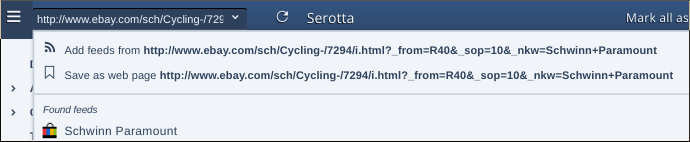
Note the “Found feeds.” That means Inoreader found an RSS feed associated with that URL. Hit RETURN. You have now set up an RSS feed for Schwinn Paramounts on eBay:

Inoreader will periodically fetch the RSS for that query and give you the opportunity display the updated list of auctions. This works for bikeforums, Velocipede Salon, Reddit, Kijiji, and many other sites.
Inoreader often knows how to modify a site’s URLs to get it to return RSS format, so you just need to enter the desired URL. You generally don't need to tweak the URL yourself to get the website to spit out RSS instead of normal HTML. If not, you can usually poke around and find an RSS feed icon. Just copy the link associated with that icon and paste it into Inoreader’s search box.
Other References
Here are some other external references which people have provided.
- Randy Jawa's My Ten Speeds site, especially his Bicycle Finding page.
Tuesday, February 09, 2016
Winter Break
I just returned from a week in Puerto Vallarta, Mexico. I heartily recommend it to anyone in need of a week in a wintertime approximation of paradise. While we have stayed in several places up and down the Bay of Banderas over the years, this time Ellen and I stayed at the Sheraton Buganvilias where her mom has a time share.
Recommended:
Restaurants
Recommended:
- Mezzogiorno, Bucerias
- Mariscos y Tostadas, Puerto Vallarta
- El Patron, Puerto Vallarta
- El Barracuda, Puerto Vallarta
Not so much:
- Blue Shrimp, Puerto Vallarta
Bike Ride
The highlight of the trip for me had to be the trip to Tepic to visit George Otis, one of my online bike buddies on the Classic Rendezvous Google Group and the Classic & Vintage forum on bikeforums.net. George has a number of very nice bikes (he rode a lovely restored Motobecane Le Champion) and loaned me a recently acquired mid-70s RIH, for a nice ride through the Nayarit countryside. From one of his pre-ride emails: "The route is a nice mix of mountains, coast, pine forest, tropical jungle, beaches, agricultural lands, etc."
George was extremely hospitable. Aside from the actual ride, he figured out the buses for me (times, locations, costs) and responded to all my questions about the sometimes tenuous situation for Americans in Mexico. (Read the State Department alerts if you're curious.) He also insisted on feeding me breakfast before we set off, complete with local yogurt and homemade passion fruit juice. After breakfast, we spent a few minutes adjusting the bike he loaned me. Then we were off.
George lives just to the east of the dormant San Juan volcano.
 Our route out Federal Hwy 76 took us around the volcano (more-or-less northwest then southwest). Tepic is around 3100 ft elevation (3149 according to MapMyRide). The route initially took us up a gradual grade. MMR tells me we topped out at 3727 feet, just before we reached the village of Guayabitos. From there, it was almost all downhill to the coast. We turned off Hwy 76 at Hwy 12, just before reaching Miramar on the coast, at an elevation of 110 feet. Aside from small climbs out of little villages tucked into ravines along the way, that represented almost 21 miles downhill. Boy, were my arms tired at the bottom! Two days later, my triceps were still sore. We did stop in a little village, Jalcocotán, where I bought some dried bananas. They are nothing more than peeled bananas which have been dried in the sun. I liked them, but wasn't able to get Ellen to try them.
Not far from the little village of Playa Platanitos, where we stopped for lunch, we stopped at a
little shrine to the Blessed Virgin, where pictures of our bikes seemed in order. I'm not sure the stop did
us much good, as I got a flat tire a bit further down the road. George mentioned that we didn't get hit by
 any cars. Maybe she only worries about the big stuff.
The short street down to Playa Platanitos was steep and heavily cobbled. Staying upright was quite a challenge. Just about the only thing in the village were four little open air restaurants situated side-by-side on the beach. George
 told me the only activity they get is on the weekends when farmers from the surrounding area come into "town." We were the only customers in the restaurant he chose. It was quite nice. I had fish, of course. On the way back out, the cobbles got us, and we both wound up walking the last little bit up to the highway.
On the final stretch to Las Varas (about 17 miles) we had a nice tailwind. We rode at a conversational pace though, so I'm sure it took well over an hour. We got to the main intersection (Hwy 12 and Hwy 200) with about 30 minutes of sunlight left. I waited for about five minutes for a bus back to Puerto Vallarta, while George headed up the hill on a bus headed to Tepic with the two bikes stored in the luggage bay.
I had a great time. It was wonderful to meet another Classic Rendezvous contact. George said it was his first opportunity to meet any of his online bike buddies, and aside from a little guided tour on rental bikes in Montreal a few years ago, it was my first opportunity to actually ride a bike outside the USA. I talked up the Dairyland Dare. George is originally from Minnesota (his parents still live there), so perhaps we can twist his arm to take a detour while visiting them next summer. That way he'd be able to meet a few other people from CR and the C&V crowd on bikeforums.net.
George was extremely hospitable. Aside from the actual ride, he figured out the buses for me (times, locations, costs) and responded to all my questions about the sometimes tenuous situation for Americans in Mexico. (Read the State Department alerts if you're curious.) He also insisted on feeding me breakfast before we set off, complete with local yogurt and homemade passion fruit juice. After breakfast, we spent a few minutes adjusting the bike he loaned me. Then we were off.
George lives just to the east of the dormant San Juan volcano.
Not far from the little village of Playa Platanitos, where we stopped for lunch, we stopped at a
The short street down to Playa Platanitos was steep and heavily cobbled. Staying upright was quite a challenge. Just about the only thing in the village were four little open air restaurants situated side-by-side on the beach. George
On the final stretch to Las Varas (about 17 miles) we had a nice tailwind. We rode at a conversational pace though, so I'm sure it took well over an hour. We got to the main intersection (Hwy 12 and Hwy 200) with about 30 minutes of sunlight left. I waited for about five minutes for a bus back to Puerto Vallarta, while George headed up the hill on a bus headed to Tepic with the two bikes stored in the luggage bay.
I had a great time. It was wonderful to meet another Classic Rendezvous contact. George said it was his first opportunity to meet any of his online bike buddies, and aside from a little guided tour on rental bikes in Montreal a few years ago, it was my first opportunity to actually ride a bike outside the USA. I talked up the Dairyland Dare. George is originally from Minnesota (his parents still live there), so perhaps we can twist his arm to take a detour while visiting them next summer. That way he'd be able to meet a few other people from CR and the C&V crowd on bikeforums.net.
Tuesday, December 01, 2015
Pushing Back on Misuse of the word Accident
I was reminded in an email thread discussing Jan Heine's recent crash in Japan about the frequently inappropriate use of the word "accident" to describe most crashes where motor vehicles hit cyclists and pedestrians (and probably fixed objects and other motor vehicles). Lynne Cooney wrote:
Again, this was not an accident, it was a negligent driver. Continuing to call these crashes "accidents" implies that they are unavoidable.Here's the beginning of the entry for "accident" on Wikipedia (emphasis mine):
An accident is an undesirable incidental and unplanned event that could have been prevented had circumstances leading up to the accident been recognized, and acted upon, prior to its occurrence. Most scientists who study unintentional injury avoid using the term "accident" and focus on factors that increase risk of severe injury and that reduce injury incidence and severity (Robertson, 2015).Lynne also provided me a link to a recent opinion piece in Wired, which I think is worthwhile reading.
The opportunity exists for a small amount of advocacy. Anytime you see the word "accident" incorrectly used in a report about a motor vehicle crash, here are a few things you can do to draw attention to the incorrect usage, yet not take much of your time:
- If the website provides for comments, add a comment to the article.
- If contact information for the author is available, tweet, post, or send an email.
- If there is a public editor or ombudsman (for instance, the NY Times has a public editor), send that person an email.
Cook up a short, polite form letter (extremely short if you are a Twitter-holic) and save it on your computer. Whenever you see the word "accident" used inappropriately to describe crashes involving motor vehicles, paste your form letter into your email/tweet/comment. On social media, include the hashtag #CrashNotAccident. Maybe reporters and news outlets will start to get the message and change their usage.
Do you already do this? Let me know in the comments. If you have a boilerplate response you use, feel free to include that as well.
Subscribe to:
Posts (Atom)