Tuesday, November 11, 2025

Hanging up my lifeguard whistle

After a bit over two years as a part-time lifeguard at the McGaw YMCA in Evanston, IL, I've decided it's time to move on. I initially became interested in becoming a lifeguard as a retiree after reading a news article in 2023 about a nationwide lifeguard shortage. I had been a lifeguard in college, but hadn't really been in the water much since letting my US Master's Swimming membership lapse after developing rotator cuff problems 10-15 years ago. I was involved in a crash with a car on my bike ride home from work in 2017 which left me with a titanium rod in my right leg and a dislocated left AC joint (the shoulder which had forced me out of the pool in the first place). After surgery and a long period of recuperation and physical therapy, I was declared "as good as new," or at least as close to that as I was ever going to get. Since then, I'd begun a more-or-less daily routine of stretching mixed with a bit of strength training thrown in.

Which brought me to 2023. After taking a swim test and a lifesving course, I was ready to go. I took a position at the Y to help reduce the lifeguard shortage. Now, the lifeguard staff has increased enough so that I can't even find a shift to pick up. This is good, but I will miss the people.

During more than two years as a lifeguard, I've come to realize how hard it is to keep the Y going. As Hillary Clinton said, it takes a village; building maintenance staff, day care staff, swim instructors and coaches, day camp counselors, personal trainers and aerobics instructors, front desk, all have a role to play.

Some things stick out in my mind's eye:

  • I see a little Head Start kid go from terrified of the water, to jumping in the water to their instructor, to crying that they have to get out. This all in the space of a single half-hour group swim lesson. It's something to behold.
  • I see many more than the four basic strokes used to get from one end of the pool to the other, FINA be damned. It's all good. Whatever keeps you moving.
  • I see people in the water who don't swim at all in the technical sense of the word, but still get the benefit of a workout in a weightless world.
  • I see young kids move up the slope of aquatics mastery.
  • I see older patrons resist the pull of gravity on the down slope of their time on this mortal plane.

I've recently gotten involved with groups resisting ICE's & CBP's invasion of our community. On the one hand it's exhilarating and another way to give back to my community, but it can also be extremely stressful. "What hammer will drop next?" is frequently on my mind. During my time in the pool yesterday, I realized about halfway through my workout that all the chaos and stress hadn't crossed my mind once. It was refreshing to get away from that for even a few minutes and recharge my mental batteries. One hand in front of the other, again, again, again, touch the wall, back the other way. It can be a meditative experience.

I haven't touched on even a tenth of what goes on at the Y; pickleball, basketball, yoga and aerobics classes, Camp Echo, even the residence section. You really ought to check out your local Y.

Tuesday, October 12, 2021

Carol Didn't Have to Die


Carol died in the wee hours of the morning on August 18, 2021. She left a gaping hole in the lives of the people closest to her. The hearts of all the people she touched will mend, but be left with invisible scars. Carol and my wife, Ellen, were besties, in the truest sense of the word. Though for the last 20 years we lived half a country away from Carol, we'd generally see her once or twice a year. She would visit her family in Michigan and swing by to hang with us for a few days, or we'd vacation together, escaping to someplace warm for a week during the depths of winter when her teaching calendar allowed. Before her cancer diagnosis several years ago, Ellen and Carol would visit major league ballparks they'd not been to before to take in a game and explore some city often unfamiliar to both of them. In between, they would talk on the phone a couple times a week, often for hours at a time.

Their friendship ran over the course of nearly forty years, encompassing the years they played and coached volleyball together, while we raised three sons, and Carol taught thousands of elementary and middle school students the practical benefits of a healthy body through physical education, my boys included. If their friendship was the sun of the solar system, I was but a minor planet orbiting in its outer reaches. Yet, if I picked up the phone when Carol called, for those few minutes until I handed the phone off to Ellen, I was at the center of that solar system. Carol was engaging and outgoing in a way I think very few other people are.

There is, of course, no single reason Carol was taken before her time. Still, she didn't have to die now. Not the way she did. I think her last few weeks are damning testimony to the way our health care system operates in the United States, denying treatment to people for no medically sound reason when they need it most. Carol is a shining example of how we can have the most advanced health care system in the world but still discard many of our citizens long before their true expiration dates. At the front end of her most recent treatment for a recurrence of her cancer she unquestionably got world class care. Somewhere though, a bean counter at an insurance company said, “I'm sorry, Carol is out of the right kind of beans.” From that point on, she was effectively locked out of the sort of treatment she required to regain her health.

I have a cycling jersey created when one of my bike buddies was diagnosed several years ago with a particularly aggressive cancer. I should get a companion jersey which reads “fuck insurance.” It's not like Carol had poor insurance or no insurance. As a public school teacher in New York, she was graced with as good an employer-provided health insurance plan as just about anyone can get. Though she died during the 2021 COVID surge, she wasn't denied an ICU bed. The surgeons and oncologists at the Dana Farber Cancer Institute and Brigham & Womens Hospital are the best in the world. She simply wasn't given enough time in rehab after surgery and radiation treatment to adequately prepare for the chemo which came next. This wasn’t because slots in rehab weren't available. It wasn't a medical decision. Her doctors said she needed more time in rehab. She had patient advocates lobbying her case. I’m sure there was no malice on the part of individual people at the insurance company who rejected requests for more rehab time. It was a parameter of her health insurance contract. It’s impossible for it to have been a medical decision. You get X days of rehab. When that’s used up, that's it.

Treatment for many forms of cancer often includes surgery, radiation, and/or chemotherapy, and in many cases (including in Carol’s original encounter with the disease) targeted maintenance therapies based upon an individual’s genetics. Rehab is required after the first three steps to give the patient time to recover before the next assault on their systems. When insurance doesn’t get in the way, the results are better. Consider a study of cancer patients at the World Trade Center Health Clinic as recounted by Dr. Steven Markowitz on a recent episode of the PBS NewsHour:

[T]he health care that's given for the responders and the residents is very good health care. It's excellent care.
And, in fact, a recent research study looking at cancer among the program participants has demonstrated that they do better in this program than they would have if they were part of the general population of New York state, in fact, 28 percent better in terms of cancer outcome, either cure and or long-term survival.

Though not the only reason for the observed better health outcomes among the WTC first responders, the authors suggest that “[t]here may be survival benefits from no‐out‐of‐pocket‐cost medical care which could have important implications for healthcare policy…” I interpret “no‐out‐of‐pocket‐cost medical care” as (at least) medical care without an insurance company dictating what is and isn’t allowed. Carol wasn’t offered the chance at a better outcome.

Over more than a century of research and practice, the medical system in the United States has developed effective treatments for many types of cancer and other chronic, life-threatening diseases, but as a side effect of wage freezes put in place during World War II, instead of anything approaching a single payer system, we wound up with a for-profit health insurance system which at the absolute worst of times can side with profit over sound medical practice. As a country we've been trying unsuccessfully ever since — starting with Harry Truman — to correct that fundamental flaw in our healthcare system. Don’t forget, everything which happens after your premium payment lands in your insurance company’s bank account lands on the loss side of the ledger for them and reduces the company’s profits. They don’t ever want to pay out on claims, and often won't unless forced to (e.g., ACA's coverage for preexisting conditions). Unless and until we decide to make the necessary changes to our healthcare system, that's how it will remain. We will probably continue to lead the world in advances in medical science, practice, technology, and expertise, yet deny many of those advances to people when they need them most.

When any suggestion of changing or eliminating our for-profit health insurance system crosses a politician’s lips (“single payer,” “Medicare for All,” "public option," etc), quotes like the following invariably turn up in the media reports and advertising: “I like my health insurance plan. Threaten it at your peril.” I assert that people saying those sorts of things have either never truly needed their insurance, or they are (perhaps unwitting) insurance industry shills. Sure, they like that their employer pays the bulk of their premiums (ignoring that that they might receive a smaller salary as a result), free shots, annual checkups and low-cost generic drugs. And remember that time little Johnny had to have his tonsils out? You didn't pay more than a small deductible. Who wouldn’t like that?

But when you have to face a truly life threatening diagnosis you quickly learn who’s making many life-or-death decisions about your care. As my father used to say, "I'll give you three guesses. The first two don't count."

Thursday, January 03, 2019

I admit it. I Cheat.

Dang. It's only January 3rd and I'm already a day behind on Januwordy. I blame it on Nova and Ultima Thule.

I admit it. I cheat. Been doing it my entire career. Remember how in school you weren't supposed to work together? Except on that end-of-year team science project, where Jeremy just goofed off and you and Cathy wound up doing all the work? I cheat in a totally acceptable way. I use open source software. I'm a so-called knowledge worker, which means the callouses are on my brain, not my hands. I've been a more-or-less free rider where my software toolbox is concerned, contributing in small ways here and there, but mostly using the work of other people. That's kind of how open source software is supposed to work. Being now much closer to the end of my career than the beginning, I'd like to reflect briefly on some of the people who worked their asses off while I goofed off.

My first job out of college was at Lawrence Livermore National Laboratory. The environment was DEC PDP-11s and VAXes with (at the time) a line-by-line editor. (DEC also had EDT on VMS which took better advantage of the terminal's real estate.) I'd gotten used to a 2D editor in school which ran on PR1ME computers and lamented its loss when I moved on, but the initial environment I used (PDP-11) didn't have EDT as I recall. One of my colleagues, Bob Schectman, said, "There's an editor on the DECUS tape. Maybe that will work for you." And thus began my ongoing love affair with Emacs. This turned out to be the Emacs implementation written by James Gosling, of Java fame. Later (and today), I used both XEmacs (Jamie Zawinski) and GNU Emacs, letting Richard Stallman and the GNU crowd do the hard stuff.

Fast forward to 1994. I had just finished up a ten-year stint at GE's Corporate R&D Center, where most of my programming was in a C/Unix environment (so I freeloaded heavily while Ken Thompson, Dennis Ritchie and Bill Joy did all the work). I had a small grant from the NSF to look at putting an interpreted front-end on C++. I had encountered similar systems at  both GE (LYMB, thank you Bill Lorenson and Boris Yamrom) and LLNL (thank you Sara Bly). I wasn't interested in developing my own programming language, so went scouting around for something I could leverage. It wasn't long before I was using Python as my front-end language, letting Guido van Rossum do most of the work. Thus began my ongoing love affair with Python. I think I owe Guido at least one beer, as Python has been the common denominator to the rest of my professional career.

Tuesday, January 01, 2019

Thoughts on the Complex Problem of Terrorism

(I started writing this piece in 2016 before Donald Trump was president. Obviously, things have changed a bit in the intervening 2+ years, but I still think it's worth contemplating the difficulty of solving the complex problem of terrorism, both imported and homegrown. I must thank Januwordy for the nudge to pick this back up.)

In The Emperor of All Maladies: A Biography of Cancer, Siddhartha Mukherjee explains why cancer is so intractable. For decades, researchers kept trying to find a silver bullet, but cancer is not one disease, and it won't succumb to a single cure. Genetically, multiple mutations often must occur for a small tumor to grow, metastasize, and become life-threatening. Multiple parts of an extremely complex system have to fail simultaneously for it to spiral out of control. Accordingly, treatment for any sort of metastatic cancer is generally multifaceted. No single part of the treatment by itself will generally send a case into remission.

I develop software for a living. It's been my observation that for things to go horribly wrong often requires multiple problems to manifest themselves simultaneously. You account for A, B, C, and D, but fail to account for E and F. Still, when E does show up, the system might well not fail, or might fail in an obvious but rather innocuous way, because it requires other problems to also manifest at the same time before the system will fail in a spectacular, expensive way. Complex systems are like that.

Similarly, as we consider how to respond to climate change (the clock is ticking), we can't be fooled into thinking that one approach will solve the problem. Everything we might do, from reducing energy usage, to increasing our use of renewable energy, to leaving fossil fuels in the ground, to climate engineering, can only be considered a partial remedy. All that and more will be necessary. It's an extraordinarily hard political problem, and sacrifices will need to be made all over the place to many established systems and ways of life if we are to get things under control.

So it is with gun violence, in all its many forms. Guns in America are part of arguably the most diverse, complex society on Earth, with people of all economic, cultural, religious, and political persuasions who (or whose ancestors) hail from everywhere imaginable. We live in rural and urban settings, in diverse communities as well as homogeneous ones. Our constitutional history has given rural residents outsized influence on the political discourse, making a rural/urban compromise less likely. We have partially melted together in this huge pot, yet often retain many elements of our ancestors' cultures for many generations. Precisely because we are a highly diverse, complex society, there is no perfect solution to the problem of guns in America, one remedy which will prevent every potential bad guy from causing mayhem with guns. If the solution to gun violence in all its forms was easy, we'd have solved it long ago.

How does this relate to terrorists bent on doing mayhem? Many things have to line up "just so" before a potential terrorist can do great harm:
  • He needs to develop intent. We say he must become "radicalized." Nobody is born with a malfunctioning terrorism gene.
  • He might need to get into the country, though as we've seen elsewhere, that is certainly not required. We (used to) have a tradition of welcoming people from all over ("Give me your tired, your poor, your huddled masses yearning to breathe free..."), in part because we are a country of immigrants and realize that on balance immigrants have been a positive force in our society.
  • He needs to identify potential targets.
  • He needs to escape detection, often for months or years.
  • He needs to acquire or make the necessary weapons and learn how to use them, again, without making anyone suspicious — and without killing himself in the process.
Tackling the problem of terrorism (here and abroad) in all its many forms will require multiple, simultaneous approaches, none of which will be perfect, all of which will require compromise. A wall on the southern border won't be sufficient (or even necessary, most people would argue). You can't build walls around all the targets (power plants, shopping malls, government buildings, electrical grids, water supplies, sporting events — the list is endless). You can't identify all the proto-terrorists when they are still teenagers. You can't prevent all the proto-terrorists from making contact with groups like ISIS or Al Qaeda. You certainly can't shoot them all. You can't find and decrypt your way into every hidden conversation. You can't keep all the AR-15s out of every possible terrorist's hands. You'll never develop and deploy perfect mental health screening processes. (Many terrorists, whether ISIS foot soldiers or homegrown white nationalists, are likely not mentally ill, anyway.) You can't expect that a one-size-fits-all approach to gun access is going to be right for Chicago, Illinois and Pleasant Ridge, Maine. And, perhaps most of all, whatever you do, you can't go trampling on our liberties, not just the right to bear arms, but our right to privacy, our right to assemble, to travel, or to pursue that sometimes elusive notion of happiness.

For those reasons and more, expecting a single approach to solve the problem is simply a pipe dream, yet that seems exactly like what our political discourse has become. Ignoring any approach — especially without performing any sort of risk/reward analysis — which might contribute to a solution in some small way is also foolish. Sure, let's work on our mental health systems, but let's also try and figure out ways to make it harder for bad people to get assault rifles. Perhaps there are better ways to protect our southern border other than a wall (in whatever form Trump envisions it). In the presence of such a complex problem, you must attack it in multiple, incomplete ways, on multiple fronts, and keep at it, searching for new ways to try to bring it to heel. More background checks won't be enough, but they will help. Better mental health screening won't be enough, but it will help. Stronger immigrant scrutiny won't be enough, but it will help. You'll need all that and more. Much more.

Anyone who thinks otherwise needs to have their head examined.

Thursday, April 14, 2016

Hunting Online for Vintage Bikes/Parts

Hunting Online for Vintage Bikes/Parts

Those of us with a penchant for vintage bikes (heck, vintage anything) can’t generally just wander into our favorite local store or check out Amazon for most of the stuff we want, and wind up spending an inordinate amount of time searching the net for interesting bits. There isn’t just one place to go to find what we are looking for. Bikes and parts are scattered all over the Internet as well as at local swap meets, auctions (both online and off), and at brick-and-mortar shops. I try below to identify (mostly online) places I hunt and techniques I use in my search for parts to complete the current project or the next project (which I really never need). I don't claim to be an expert. These are just sites and tools I've discovered.

Places to search

There are an amazing number of places on the Internet to search for vintage bikes and parts. Here are the ones I know about which have a reasonable chance of yielding some useful hits. I’m sure there are more. As you get more and more into hunting for that unique bike or obscure part to complete your tout Mavic group, you will likely wind up searching sites which are not in your native language. You likely have to rely on Google Translate, but that won’t be perfect (for example, it will translate your use of the brand name “Galli” into “Rooster” when searching Italian sites). You probably want to track down a copy of the multilingual bicycle parts guide found in Sutherland’s Handbook for Bicycle Mechanics. (Actually, if you don’t have it, you want your own copy of this tome.) I have a 3rd edition. I’m not sure if the latest editions have the translator, but they probably do.


Here’s what I know about (let me know about others):


Search techniques/tools

With all those sources (and more), there is no way you can follow everything. Trust me, I’ve tried. Ask my wife how much time I spend staring at my phone. Over the past few years, I have tried all sorts of techniques, including following specific searches or sellers on eBay, or using specialty search sites like Searchdome (e.g., “show me auctions for Brooks saddles with no bids and less than an hour remaining”). While I still rely on specific searches to drill down into a particular site’s offerings, I’ve increasingly turned to RSS feeds as my preferred way to aggregate those search results into a single interface.

RSS Feeds

After a long time picking through emails from eBay, Searchdome, and various bike forums, I started to lament the fact that results from different sources were formatted differently, my inbox was inundated by extra email I sometimes wanted to just ignore (for awhile), and some non-email possibilities required me to return to specific websites from time-to-time (causing me to sometimes miss opportunities). About this time, Google dumped their Reader product (a rather snazzy RSS feed reader), which I’d been using as my browser home page. Casting about for a replacement, I settled on Inoreader. It’s not as fancy as Google Reader was, but it gets the job done.


The key to making this work is to find RSS feeds for specific pages and search queries. Sometimes it’s not immediately obvious, but many (though, unfortunately, not all) sites with search facilities (eBay, Craigslist, bikeforums, etc) support RSS feeds. RSS feeds can be for large groups or specific queries.


Here’s an example of how I set up an eBay search in Inoreader. Create an eBay query for, say, “Schwinn Paramount,” in the Cycling category, sorted by time newly listed. This last bit is important! The default sort order in eBay is by “Best Match.” Since you want to see new auctions as they are listed, you want to sort by “Time: newly listed,” otherwise you might see that spectacular 1950’s Cinelli stem badge you’ve been searching for just as (or just after) the auction completes.


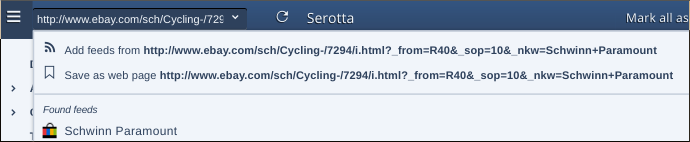
Now, copy that URL in your browser, head on over to your Inoreader tab, and paste it into the search form in the upper left corner.

search.png

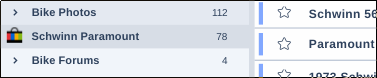
Note the “Found feeds.” That means Inoreader found an RSS feed associated with that URL. Hit RETURN. You have now set up an RSS feed for Schwinn Paramounts on eBay:

para.png

Inoreader will periodically fetch the RSS for that query and give you the opportunity display the updated list of auctions. This works for bikeforums, Velocipede Salon, Reddit, Kijiji, and many other sites.

Inoreader often knows how to modify a site’s URLs to get it to return RSS format, so you just need to enter the desired URL. You generally don't need to tweak the URL yourself to get the website to spit out RSS instead of normal HTML. If not, you can usually poke around and find an RSS feed icon. Just copy the link associated with that icon and paste it into Inoreader’s search box.

Other References

Here are some other external references which people have provided.

Tuesday, February 09, 2016

Winter Break

I just returned from a week in Puerto Vallarta, Mexico. I heartily recommend it to anyone in need of a week in a wintertime approximation of paradise. While we have stayed in several places up and down the Bay of Banderas over the years, this time Ellen and I stayed at the Sheraton Buganvilias where her mom has a time share.


Restaurants


Recommended:
Not so much:
  • Blue Shrimp, Puerto Vallarta

Bike Ride

The highlight of the trip for me had to be the trip to Tepic to visit George Otis, one of my online bike buddies on the Classic Rendezvous Google Group and the Classic & Vintage forum on bikeforums.net. George has a number of very nice bikes (he rode a lovely restored Motobecane Le Champion) and loaned me a recently acquired mid-70s RIH, for a nice ride through the Nayarit countryside. From one of his pre-ride emails: "The route is a nice mix of mountains, coast, pine forest, tropical jungle, beaches, agricultural lands, etc." 

George was extremely hospitable. Aside from the actual ride, he figured out the buses for me (times, locations, costs) and responded to all my questions about the sometimes tenuous situation for Americans in Mexico. (Read the State Department alerts if you're curious.) He also insisted on feeding me breakfast before we set off, complete with local yogurt and homemade passion fruit juice. After breakfast, we spent a few minutes adjusting the bike he loaned me. Then we were off.

George lives just to the east of the dormant San Juan volcano.

Our route out Federal Hwy 76 took us around the volcano (more-or-less northwest then southwest). Tepic is around 3100 ft elevation (3149 according to MapMyRide). The route initially took us up a gradual grade. MMR tells me we topped out at 3727 feet, just before we reached the village of Guayabitos. From there, it was almost all downhill to the coast. We turned off Hwy 76 at Hwy 12, just before reaching Miramar on the coast, at an elevation of 110 feet. Aside from small climbs out of little villages tucked into ravines along the way, that represented almost 21 miles downhill. Boy, were my arms tired at the bottom! Two days later, my triceps were still sore. We did stop in a little village, Jalcocotán, where I bought some dried bananas. They are nothing more than peeled bananas which have been dried in the sun. I liked them, but wasn't able to get Ellen to try them.

Not far from the little village of Playa Platanitos, where we stopped for lunch, we stopped at a

little shrine to the Blessed Virgin, where pictures of our bikes seemed in order. I'm not sure the stop did us much good, as I got a flat tire a bit further down the road. George mentioned that we didn't get hit by
any cars. Maybe she only worries about the big stuff.

The short street down to Playa Platanitos was steep and heavily cobbled. Staying upright was quite a challenge. Just about the only thing in the village were four little open air restaurants situated side-by-side on the beach. George
told me the only activity they get is on the weekends when farmers from the surrounding area come into "town." We were the only customers in the restaurant he chose. It was quite nice. I had fish, of course. On the way back out, the cobbles got us, and we both wound up walking the last little bit up to the highway.


On the final stretch to Las Varas (about 17 miles) we had a nice tailwind. We rode at a conversational pace though, so I'm sure it took well over an hour. We got to the main intersection (Hwy 12 and Hwy 200) with about 30 minutes of sunlight left. I waited for about five minutes for a bus back to Puerto Vallarta, while George headed up the hill on a bus headed to Tepic with the two bikes stored in the luggage bay.

I had a great time. It was wonderful to meet another Classic Rendezvous contact. George said it was his first opportunity to meet any of his online bike buddies, and aside from a little guided tour on rental bikes in Montreal a few years ago, it was my first opportunity to actually ride a bike outside the USA. I talked up the Dairyland Dare. George is originally from Minnesota (his parents still live there), so perhaps we can twist his arm to take a detour while visiting them next summer. That way he'd be able to meet a few other people from CR and the C&V crowd on bikeforums.net.

Tuesday, December 01, 2015

Pushing Back on Misuse of the word Accident


I was reminded in an email thread discussing Jan Heine's recent crash in Japan about the frequently inappropriate use of the word "accident" to describe most crashes where motor vehicles hit cyclists and pedestrians (and probably fixed objects and other motor vehicles). Lynne Cooney wrote:
Again, this was not an accident, it was a negligent driver.  Continuing to call these crashes "accidents" implies that they are unavoidable.
Here's the beginning of the entry for "accident" on Wikipedia (emphasis mine):
An accident is an undesirable incidental and unplanned event that could have been prevented had circumstances leading up to the accident been recognized, and acted upon, prior to its occurrence. Most scientists who study unintentional injury avoid using the term "accident" and focus on factors that increase risk of severe injury and that reduce injury incidence and severity (Robertson, 2015).
Lynne also provided me a link to a recent opinion piece in Wired, which I think is worthwhile reading.

The opportunity exists for a small amount of advocacy.  Anytime you see the word "accident" incorrectly used in a report about a motor vehicle crash, here are a few things you can do to draw attention to the incorrect usage, yet not take much of your time:

  • If the website provides for comments, add a comment to the article.
  • If contact information for the author is available, tweet, post, or send an email.
  • If there is a public editor or ombudsman (for instance, the NY Times has a public editor), send that person an email.

Cook up a short, polite form letter (extremely short if you are a Twitter-holic) and save it on your computer. Whenever you see the word "accident" used inappropriately to describe crashes involving motor vehicles, paste your form letter into your email/tweet/comment. On social media, include the hashtag #CrashNotAccident. Maybe reporters and news outlets will start to get the message and change their usage.

Do you already do this? Let me know in the comments. If you have a boilerplate response you use, feel free to include that as well.

Monday, November 09, 2015

Crunch

I think there is a noise everybody makes without thinking when their lower level neural circuits determine that they are suddenly at great risk of injury. For me, it's "Whoa! Whoa! Whoa!". Not two or four "whoas," three. It's unconscious, erupting before you even form the thought that you are in trouble. I guess that comes from the fast circuits Daniel Kahneman wrote about in Thinking Fast and Slow. If I am not in as much immediate danger, my higher cortical functions take over, resulting in a well-formed sentence which often includes one or two four-letter words.

Today, I got doored. It happened so quickly I didn't even have time to utter my fast phrase. As I was falling I ever-so-briefly formed an image of laying down, as I usually sleep on my left side, which was the side about to contact the pavement. Very weird. I'll be fine, though now about nine hours after the incident, I do have some aches and pains. I might well be off the bike for a couple days. My bike sustained a few scuffs as well - including to my Brooks Pro :-( - but the big parts all seem fine. I guess there is an advantage (for the bike) that the rider is a skosh wider than the bike. I think I was pretty lucky, all things considered.

The after-incident was kind of weird as well. Obviously, the driver finished getting out of her car, and asked if I was okay. There was also a guy over on the sidewalk who kept asking, "Are you okay?" Sort of like Sheldon Cooper on Big Bang Theory and his "knock-knock-knock, Penny?" bit, only this guy wasn't going to stop asking if I was okay until I said something. So, after about his eighth repetition, I said something just to shut him up. I think he was in an infinite loop. After getting up, I examined my bike, concluded everything looked fine, certainly well enough to ride home, then exchanged phone numbers with the driver, so I could contact her later if I had problems.

The final icing on the cake was applied as I was getting back on my bike. The guy who just a moment before was repetitiously concerned that I was okay, started giving me a hard time for not chatting up the driver. She was kind of a hottie. Honestly, that was the last thing on my mind. I am a happily married man, and have been for 34 years. Hotties haven't been on the menu (not even the menu of my impossible dreams) for a great long while.

Wednesday, November 04, 2015

Don't Expect Perfection

Chicago has has an excellent history of bike-friendly mayors. Richard M. Daley was responsible for much of our cycling infrastructure. His successor, Rahm Emanuel has built aggressively on Mayor Daley's legacy. In fact, Richard J. Daley was responsible for designating the Lakefront Trail as a bike path, in 1963!

LFT is one of the most heavily trafficked multi-use paths around. Strava has a nice little interactive heatmap which you can use to identify heavily used and timed routes. As you can see, LFT is well used both by cyclists:


and runners:


The work to straighten out LFT at Fullerton Avenue is about complete. Yesterday, I stopped at the construction site entrance and spoke with Catrina, the traffic coordinator. She said the upgraded path should be open soon.

We got into a short discussion, during which she asked, "are you one of those speeders?" I knew what she meant by the term, and didn't feel like it necessarily fit me. I explained, rather vaguely, that I do ride fast when the coast is clear, and waved my hand generally toward the north. She said she has seen a number of accidents involving bikes at that location. The detour is a bit problematic, involving a chicane around the Theater on the Lake, narrowing of the path, and obstruction of any remaining sight lines by the green fabric on the chain link fence used to block prying eyes from the construction site.

Feeling like I hadn't explained myself very well, I started thinking about why me riding fast "up north" wasn't the same as the Lakefront Lances bombing through the detour around the construction zone. I've written about right-of-way before. I try to ride by that rule: never steal someone else's right-of-way. Still, that one rule doesn't totally explain how I try to ride, or how I think others should ride (or drive). I don't think it explains all the collisions Catrina has seen either.

I was missing something. Yesterday, while mulling over the conversation, it came to me: don't expect perfection. Simply put, when you ride too fast for conditions, you are expecting perfection from yourself and from others around you. If you buzz through congestion on the trail at 20mph, you leave no margin for error. You can't afford to make a mistake. Nor can the runner who has just reached her turn-around point and wants to head home and get ready for work. Nor can the bike mechanic who replaced your brake cables last week. Nor can the squirrel off the path being chased by the dog running off-leash. Nor, for that matter, can the dog. You implicitly expect perfection in every one of these small interactions.

Perhaps this is one of the reasons I don't enjoy group rides as much as I might. I like going faster than I normally would riding solo, and I like the common purpose and camaraderie of the people I ride with. I am a bit skeptical of my own expertise, which makes me nervous riding in a pace line. In addition, I don't want my riding buddies to have to pay for the mistakes I learn as I gain proficiency.

So, my informal cycling rule book now has two simple rules:
  • Don't steal the right-of-way.
  • Don't expect perfection.

Sunday, November 01, 2015

Daylight, Daylight, Where For Art Thou?

So, the clocks fell back again last night. At least here in the US of A. I'm sure there are plenty of other posts on the subject (here's one which caught my eye), but I will add one more.

I have a hard enough time sleeping. I don't need extra, artificial, impediments to my already faulty circadian rhythms. This morning, after the overnight time change, I wound up getting up shortly after 4am (5 o'clock would have been bad enough). On a Sunday, for chrissakes!

Starting tomorrow, I can look forward to several months where I ride my bike to and from work in pretty much complete darkness. While nighttime riding is fun on occasion, I'm sure my risk of injury roughly doubles when I go from riding one way in darkness to two. And it probably adds a little bit to my lovely wife's stress to know I'm out there pedaling in darkness. Note to other cycling commuters: make sure your lights are fully charged before heading off to work tomorrow morning.

I work at a trading firm which (like almost all others) trades markets worldwide. The change from Daylight to Standard time, especially now that Europe and the US don't change at the same time, is annoying, at best. Given the differing change dates here and on the continent, we now have four points where problems can arise, two in the spring, two in the fall. To try and remain in sync with American traders, some overseas exchanges actually change their open and close times so we don't see a change relative to our clock! I'm sure there are other industries where the Spring and Fall clock rituals are more problematic (and attempts at adaptation even more absurd).

Permanent DST sounds like an excellent idea to me. Can we please stop messing with the clocks?

Friday, October 30, 2015

The God of Salt Can be an Angry God

I ride an old Trek set up as a fixed gear much of the time, and it's pretty much my full-time winter ride.  (I have a couple other bikes I don't really mind sacrificing to the God of Salt, but I don't ride them much.) The pedals on the Trek have been complaining recently (creaking, mostly), so I figured it was time to service them.

I had another set of pedals ready to install, so this morning I went to do the swap.  Oops.  Not really turning.  I managed to get the drive side pedal off, and noticed some corrosion on the pedal threads.  Good old bimetallic electrochemistry at work, aided and abetted by the God of Salt.  On the non-drive side, I could barely get the pedal to budge.  I shot it with a bit of Liquid Wrench, greased the drive side pedal, reinstalled it, then rode to work.

On the NDS, the shoulder that normally butts up against the crank arm is now moved back just a skosh from the face of the crank arm.  Under normal circumstances, much (most? all?) of the force is transmitted between the pedal and the crank through that interface.  I hope the Liquid Wrench and easy pedaling will free up the threads a bit so I can remove the pedal this evening without applying heat.  Still, you should take advantage of my mistake (I should have been checking all steel/aluminum interfaces periodically, especially on a bike that sees winter's road salt - shame on me), and check your pedals, seatpost, and stem before they become permanent fixtures on your bike.

Monday, October 19, 2015

Phyllis

My oldest cousin Phyllis passed away recently. Naturally, I've been thinking a lot about her in the time since. Just as naturally (if you know me), it's taken me awhile to collect my thoughts and decide to put them down. I started writing this a couple days ago, on my way to the memorial service, somewhere between Portland and Seattle, sipping my coffee, trying to organize a few thoughts in a coherent way.

Phyllis has always been special to me, not because we grew up together or kept in very close touch during our adult lives, but because she stepped into my life in a significant way when I needed it most. My father died suddenly just after I graduated from high school. Though it wasn't always so, the Montanaro clan was always geographically dispersed during my lifetime. My dad and I lived in the Bay Area. My Grandma and various aunts and uncles came out west for the funeral from Chicago, Connecticut, and Miami. Phyllis came down from her home near Seattle.

After the funeral, most everyone returned to their lives far away, but Phyllis stayed. In talking with my cousins Pat and Judy, and my cousin-in-law Bob, I more-or-less confirmed my 45-year memories that she stayed for a couple weeks, went home at some point, then returned. I'm not sure how long she was there in total, but it was a very significant commitment of her time, and must have placed a burden on Bob and their children as well.

There was a lot to do, essentially none of which I remember any longer, much of it probably mundane stuff which just had to get done. I was a seventeen year-old kid, about to head off to college in the fall. I'm sure I hadn't any idea what to do. But Phyllis certainly did. You see, her dad, my Uncle Jim, died suddenly when she was seventeen. While the circumstances were much different, there was still that strong similarity, losing your father at a time when you can least afford it, just as you're about to head out into the world on your own, and like it or not, need advice and sometimes a nudge in the right direction. I think she, better than anyone else, understood my situation, and stepped in to help.

During the past couple days, visiting with a good chunk of my extended Montanaro family for the first time in a long while, I heard phrases like "love and strength" and "second mom" used repeatedly to describe Phyllis. I think she was the embodiment of those concepts, and I will always be grateful for her presence in my life.

Wednesday, October 07, 2015

Bicycle Lighting

Over the last several years, cycling has witnessed a sort of lighting arms race, with brightness now measured in hundreds of lumens. I'm sure that by now some company has broken the kilolumen barrier. It's gotten to the point where many morning Freds ride around with lights on their helmets whose brightness rivals Hollywood premiere search lights. If several Freds are riding in a pack, it can look pretty much like this image from the 1940 premiere of Charlie Chaplin's The Great Dictator.


To make matters worse, riders wearing these photonic cannons think nothing of looking at other people passing by, briefly searing their retinas and rendering them momentarily blind. This is far from a good thing when you are riding on a multi-use path with other cyclists, joggers, pedestrians and the occasional dog, who have suddenly become invisible to you.

These multi-hundred dollar portable searchlights have their uses off-road, where there is little other natural light to light the way. They really have little, if any, use on bike paths or city streets. I can understand the desire to see and be seen, but I doubt riders with such headlamps are increasing their safety on surface streets when they blind drivers in two-ton metal cages either.